
You have been so focused on getting through treatment that you forgot you are allowed to feel cared for in the middle of it.
If you or someone you love is navigating a cancer diagnosis, you may have wondered whether massage is safe — or whether it's even appropriate — during treatment or recovery.
The answer is yes. With the right practitioner, the right approach, and the right communication, massage can be one of the most meaningful forms of support available during a cancer journey.
This guide is for patients, survivors, and the caregivers who love them. It covers what oncology massage is, how it differs from regular massage, what a session looks like at Onyeka Tefari Wellness & Spa, and who it's most beneficial for.
What Is Oncology Massage?
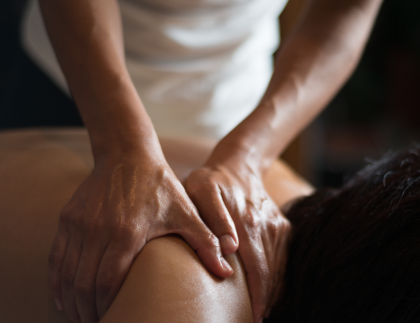
Oncology massage is a specialized form of massage therapy adapted specifically for people who have been diagnosed with cancer — whether they are in active treatment, in recovery, or living with the long-term effects of cancer and its treatment.
It is not simply regular massage with lighter pressure. It is a fundamentally different approach that requires specific training, ongoing education, and a deep understanding of how cancer and its treatments affect the body.
A trained oncology massage therapist knows how to modify every aspect of a session — pressure, positioning, technique, areas to avoid, and duration — based on each client's unique situation. What that looks like for someone in active chemotherapy is very different from what it looks like for someone six months post-mastectomy, which is different again from someone managing lymphedema two years after treatment ended.
No two oncology massage sessions are exactly alike. That is by design.
How Is It Different From Regular Massage?
The differences are significant and worth understanding clearly.
Pressure Standard massage uses moderate to firm pressure to work with muscles and connective tissue. Oncology massage uses much lighter pressure — particularly over areas affected by treatment, surgical sites, or compromised tissue. This is not simply a preference; it is a clinical necessity. Skin, tissue, and bone can be significantly more vulnerable during and after cancer treatment, and pressure that would be appropriate for a healthy body can cause harm to a body in treatment.
Positioning Many clients in treatment cannot lie flat on a table comfortably — due to surgical sites, port placement, fatigue, or pain. An oncology massage therapist is trained to use bolsters, pillows, and alternative positioning to ensure every client is fully supported and comfortable throughout the session.
Areas to avoid There are specific areas an oncology massage therapist will not work directly on — including tumor sites, radiation fields that are currently being treated, areas of active infection or open wounds, and lymph node regions that have been removed or irradiated. Knowing what to avoid is as important as knowing what to do.
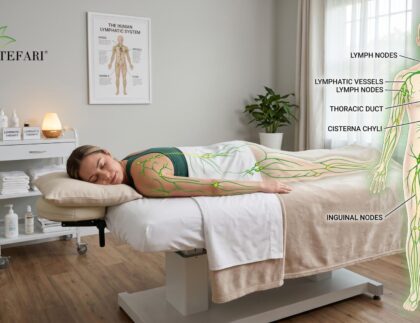
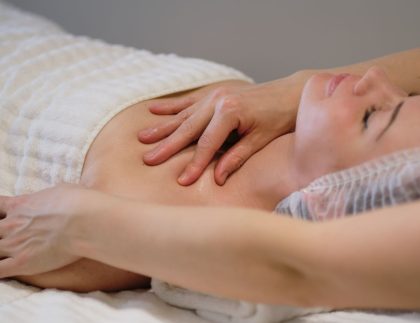
Lymphatic awareness For clients who have had lymph nodes removed — particularly those who have had mastectomy, lumpectomy, or other procedures involving the axillary nodes — there is a risk of lymphedema that must be carefully considered. An oncology massage therapist works with that awareness in every session, and may incorporate Manual Lymphatic Drainage (MLD) techniques as part of the treatment.
Communication An oncology massage session begins with a thorough intake conversation — more detailed than a standard massage intake. Your therapist will want to know your diagnosis, where you are in your treatment timeline, what procedures you have had, what medications you are taking, and how you are feeling that day. This is not bureaucracy. It is the foundation of safe, effective care.
What Are the Benefits?
The research on oncology massage is growing, and what it consistently shows is meaningful. Oncology massage has been shown to:
Reduce anxiety and emotional distress A cancer diagnosis and the treatment that follows can create a level of anxiety that is genuinely hard to describe to someone who hasn't experienced it. The body holds that anxiety. Skilled, intentional touch helps the nervous system find moments of safety and calm — which is not a small thing when your days are structured around appointments, decisions, and uncertainty.
Support better sleep Many people in treatment report significant disruption to their sleep — from discomfort, from anxiety, from the physiological effects of chemotherapy and radiation. Regular massage has been shown to support improved sleep quality, which matters enormously for recovery and immune function.
Ease treatment-related fatigue Cancer-related fatigue is one of the most common and most undertreated side effects of cancer treatment. It is different from ordinary tiredness and does not always resolve with rest. Massage supports circulation, reduces muscle tension, and helps the nervous system shift into a more restorative state — all of which can ease the particular heaviness of treatment fatigue.
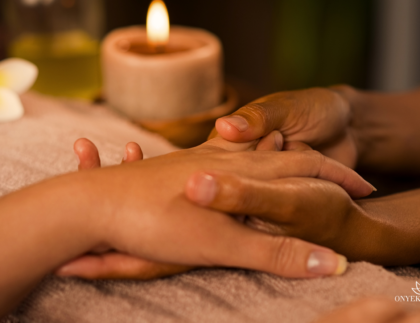
Reduce nausea Some clients find that massage — particularly gentle work on the hands, feet, and upper back — helps reduce treatment-related nausea. While it is not a substitute for medical antiemetic treatment, it can be a meaningful complement to it.
Address pain and physical discomfort Surgical pain, neuropathy from chemotherapy, muscle tension from positioning during treatment, joint discomfort — these are all areas where skilled, adapted massage can provide genuine relief.
Provide human touch in a clinical journey This one is harder to quantify but may be the most important. Cancer treatment involves a great deal of touch — but most of it is clinical. Needles, ports, scans, examinations. Very little of it is touch that asks nothing of you and exists simply to offer comfort.
Many clients tell me that their session is one of the few hours in their week where someone's entire focus is on their comfort. Not their labs. Not their prognosis. Not what comes next. Just them, in this moment, being cared for.
That is not incidental to healing. It is part of it.
Who Is Oncology Massage For?
Oncology massage is appropriate for people at every stage of the cancer journey:
During active treatment Chemotherapy, radiation, immunotherapy, targeted therapy — oncology massage can be safely offered during all of these, with appropriate modifications. Sessions during active treatment tend to be shorter and gentler, focused on comfort and nervous system support.
After surgery Post-surgical massage — including work around mastectomy sites, reconstruction, lumpectomy, and other cancer-related surgeries — is one of the most common reasons clients come to us. Massage can support tissue healing, reduce scar tissue formation, address postural changes that develop after surgery, and provide relief from the discomfort that often persists long after the surgical wound has closed.
During recovery and survivorship Many of the effects of cancer treatment persist long after treatment ends — fatigue, neuropathy, lymphedema risk, emotional processing, body image changes. Oncology massage during survivorship supports the body's return to itself and gives clients a consistent space to process the experience of what they have been through.
For people living with metastatic cancer Palliative oncology massage — focused entirely on comfort and quality of life — is appropriate and meaningful for people living with advanced or metastatic disease. The goal is not cure. It is care.
For caregivers This one is often overlooked. Caregivers carry an enormous physical and emotional load, and they rarely prioritize their own care. A session for the caregiver is not a luxury — it is an acknowledgment that you cannot pour from an empty vessel, and that what you are doing is hard.
What Happens in a Session at Onyeka Tefari?
When you arrive for your first oncology massage session at Onyeka Tefari Wellness & Spa, here is what you can expect:
A thorough intake conversation Before we begin, we will sit together and talk through your health history, your diagnosis, where you are in your treatment, any procedures you have had, medications you are currently taking, and how you are feeling today. This conversation is confidential and unhurried. There is no wrong answer and nothing you need to manage or soften for me.
A fully adapted session Based on our intake conversation, I will adapt every element of your session — pressure, positioning, techniques, areas of focus, and areas to avoid — to exactly where your body is right now. This may look very different from a standard massage, and that is intentional.
A pace set entirely by you If you need to stop, rest, or adjust at any point, you can. There is no agenda in this room beyond your comfort and care.
Privacy and dignity throughout You will be draped and positioned with full attention to your comfort and dignity. If there are areas of your body you are not ready to have worked on — including surgical sites, reconstruction, or areas of significant sensitivity — we will honor that completely.
An honest conversation at the end After your session we will check in briefly about how you felt and what you noticed. This helps me adapt future sessions and ensures you leave with whatever information is most useful to you.
A Note on Working Alongside Your Medical Team
Oncology massage is a complementary therapy. It works alongside your medical treatment — it does not replace it, and it is not in competition with it.
If your medical team has questions about whether massage is appropriate for you at a particular point in your treatment, we welcome that conversation. Many oncologists and nurses are supportive of oncology massage as part of a comprehensive care approach. If it would be helpful, I am happy to provide information about my training and approach that you can share with your care team.
Manual Lymphatic Drainage and Oncology
For clients who have had lymph nodes removed — particularly following breast cancer surgery — Manual Lymphatic Drainage (MLD) is often an important part of their care.
Lymphedema, the chronic swelling that can develop when the lymphatic system has been disrupted by surgery or radiation, affects a significant number of breast cancer survivors. It can develop months or even years after treatment ends, and it is a lifelong condition that requires ongoing management.
MLD is one of the most effective treatments for lymphedema. It is gentle, specific, and performed by a therapist trained in the anatomy of the lymphatic system and the pathways that need support when nodes have been removed.
At Onyeka Tefari we offer both oncology massage and MLD, and for many of our clients the two work together as a comprehensive approach to post-surgical care and long-term lymphatic health.
Learn more about our MLD services here.
You Are Welcome Here
If you are navigating a cancer journey — at any stage, in any form — you are welcome at Onyeka Tefari Wellness & Spa.
You do not need to explain everything. You do not need to be further along in your recovery. You do not need to be strong or composed or certain about what you need.
You just need to show up. We will take it from there.
Book an oncology massage session | Learn about MLD for post-surgical care | Contact us with questions
Onyeka Tefari Wellness and Spa offers Oncology Massage and Manual Lymphatic Drainage in San Diego, CA. Located at 8755 Aero Drive Suite 225, San Diego, CA 92123. Book online at onyekatefari.com.
JOIN OUR LYMPHADEMA SUPPORT GROUP ON FACEBOOK!
We have a supportive community where you can connect with others facing similar challenges. Click the link below to join:
Related Products



Related Services
Feel our
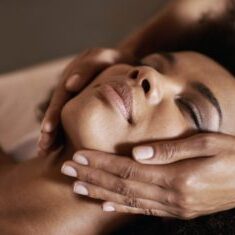
Oncology Massage
Embark on a journey of healing and tranquility with our specialized Oncology Massage, a form of soft-tissue mobilization designed to bring comfort and support to those navigating the challenges of cancer treatment.
Unique
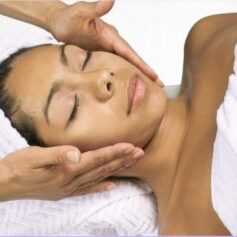
Manual Lymphatic Drainage
Manual Lymphatic Drainage massage is a form of soft-tissue mobilization dramatically enhances lymph formation and promotes drainage within the superficial and deep systems of the lymph vascular network.

Unique
Synergistic Massage
The Synergistic Massage Integrates both Eastern & Western healing methods to restore the harmonious flow of life within. It combines the nurturing Western oil massage with the therapeutic benefits of Asian bodywork methods.